
WhatsApp marketing in India has gone from a nice-to-have to one of the highest-ROI channels a business can run. With more than 500 million WhatsApp users in the country, open rates above 90%, and reply rates email can only dream of, it is often the single channel that decides whether a lead converts. This guide covers exactly how to do WhatsApp marketing the right way in 2026 — the official WhatsApp Business API, proper opt-ins, templates that convert, and the mistakes that get numbers banned.
Why WhatsApp marketing works in India
India has more WhatsApp users than any other country on earth. It is the primary messaging app for most of the population — across urban and rural areas, across age groups, and across income levels. When your customers already spend hours a day on WhatsApp, meeting them there removes almost all friction from the buying journey.
Three structural advantages make the channel especially powerful in India: UPI and WhatsApp Pay let a customer go from interest to payment inside a single app; Click-to-WhatsApp ads turn paid social into live conversations instead of cold landing-page clicks; and WhatsApp’s deep penetration into Tier 2 and Tier 3 cities reaches hundreds of millions of buyers who are hard to reach any other way.
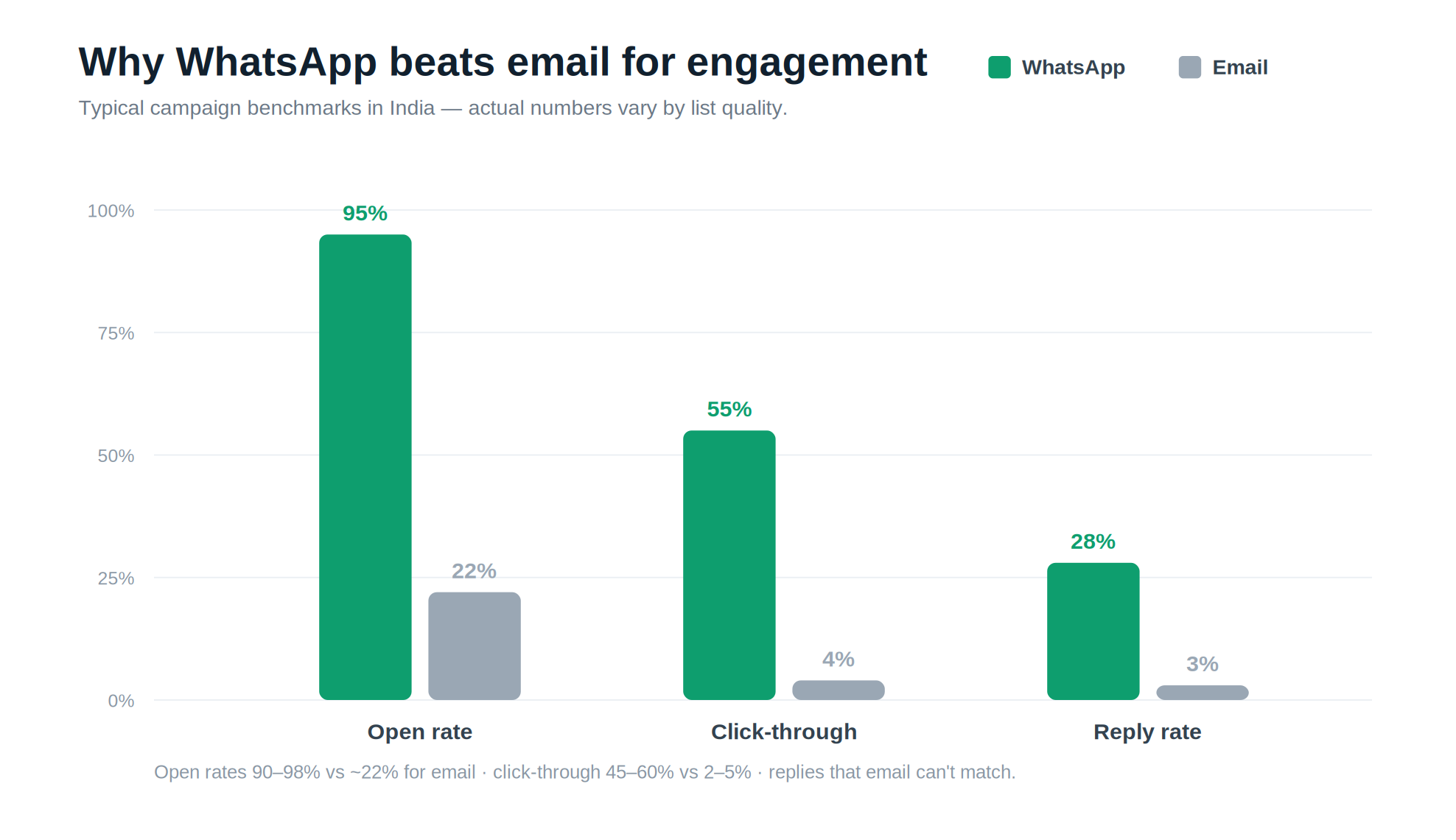
The engagement numbers back this up. WhatsApp messages typically see:
- Open rates of 90–98% — compared to 20–25% for email
- Click-through rates of 45–60% on messages with a clear CTA — email CTRs average 2–5%
- Reply rates of 15–35% on marketing templates — almost unheard of for any other broadcast channel
The caveat: those numbers assume you are sending to people who actually want to hear from you. The moment you message people without consent, the numbers invert — high block rates, a falling quality rating, and eventually a WhatsApp ban that takes your number offline.
Official API vs. unofficial tools
Before anything else: the only safe way to do WhatsApp marketing at scale is through the official WhatsApp Business Platform API, accessed through a Meta-approved Business Solution Provider (BSP).
Unofficial tools that automate WhatsApp Web or use modified APKs look attractive because they are cheaper and skip template approval. They will get your number banned — sometimes within hours. Meta runs automated systems that detect bulk sends from unofficial channels, and there is no appeals process that reliably recovers a banned number.
The three types of WhatsApp marketing
Not everything that works on email or SMS maps cleanly to WhatsApp. Effective WhatsApp marketing generally falls into three categories:
1. Broadcast campaigns
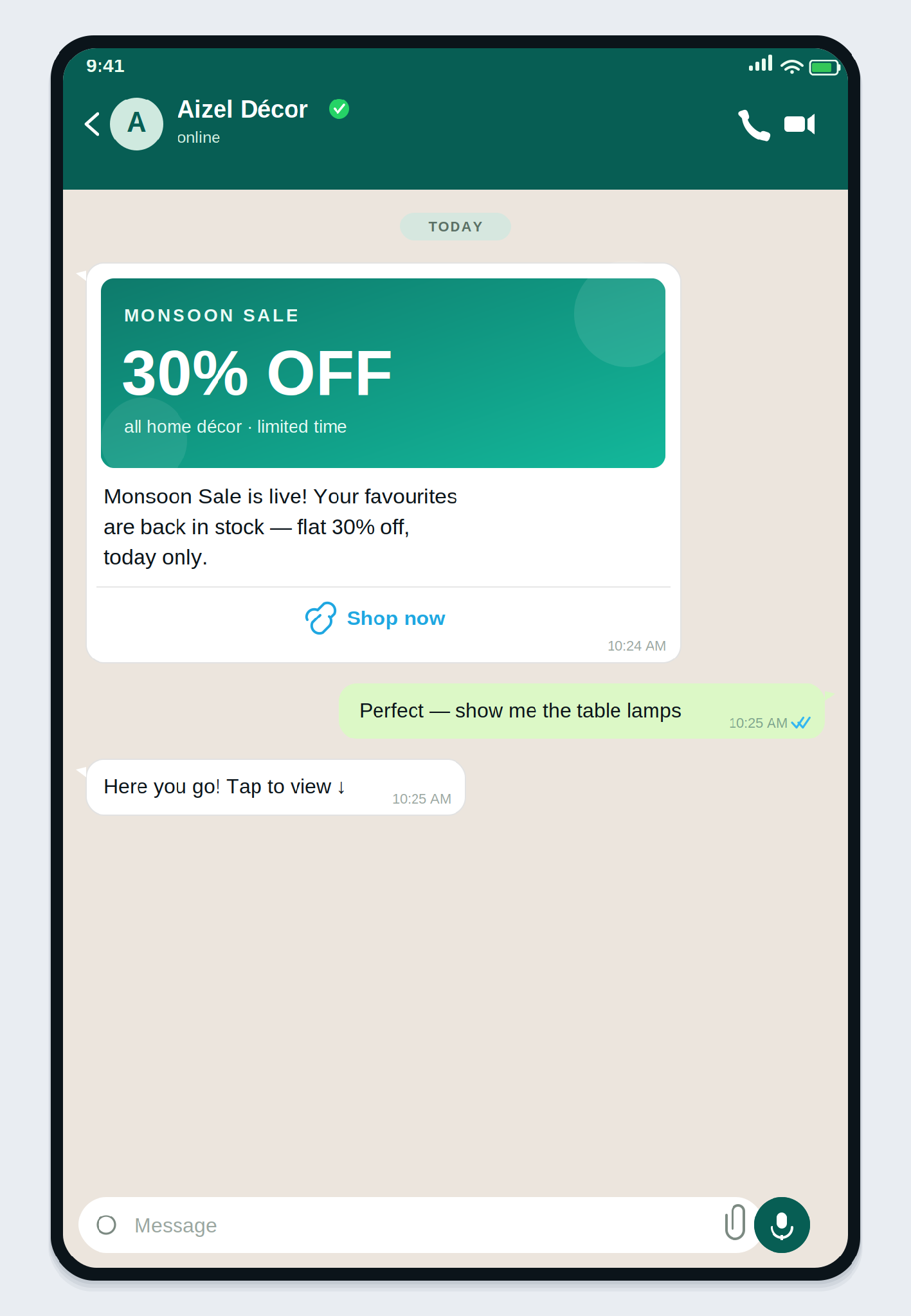
One-to-many messages sent via approved templates to opted-in contacts: product launches, seasonal sales, restock alerts, loyalty updates. They are the WhatsApp equivalent of an email newsletter, but with dramatically higher open rates. Best for: e-commerce, D2C, retail, travel, and any business with a list of customers who have explicitly opted into promotional WhatsApp messages.
2. Triggered transactional messages
Automated messages sent in response to a customer action — an order placed, a payment made, an appointment confirmed. A customer who gets a clear order confirmation on WhatsApp is more likely to buy again than one who got no confirmation at all. Best for: any business with transactions — e-commerce, BFSI, healthcare, hospitality.
3. Conversational marketing
Two-way conversations where your business engages prospects individually — Click-to-WhatsApp ads, WhatsApp widgets on your site, and QR codes on packaging that start a chat. A well-configured AI agent handles the conversation, qualifies the lead, and either converts directly or hands off to a human agent. Best for: high-consideration purchases (real estate, insurance, financial products, B2B SaaS) where a conversation dramatically outperforms a landing page.
Click-to-WhatsApp ads: the fastest way to build a list
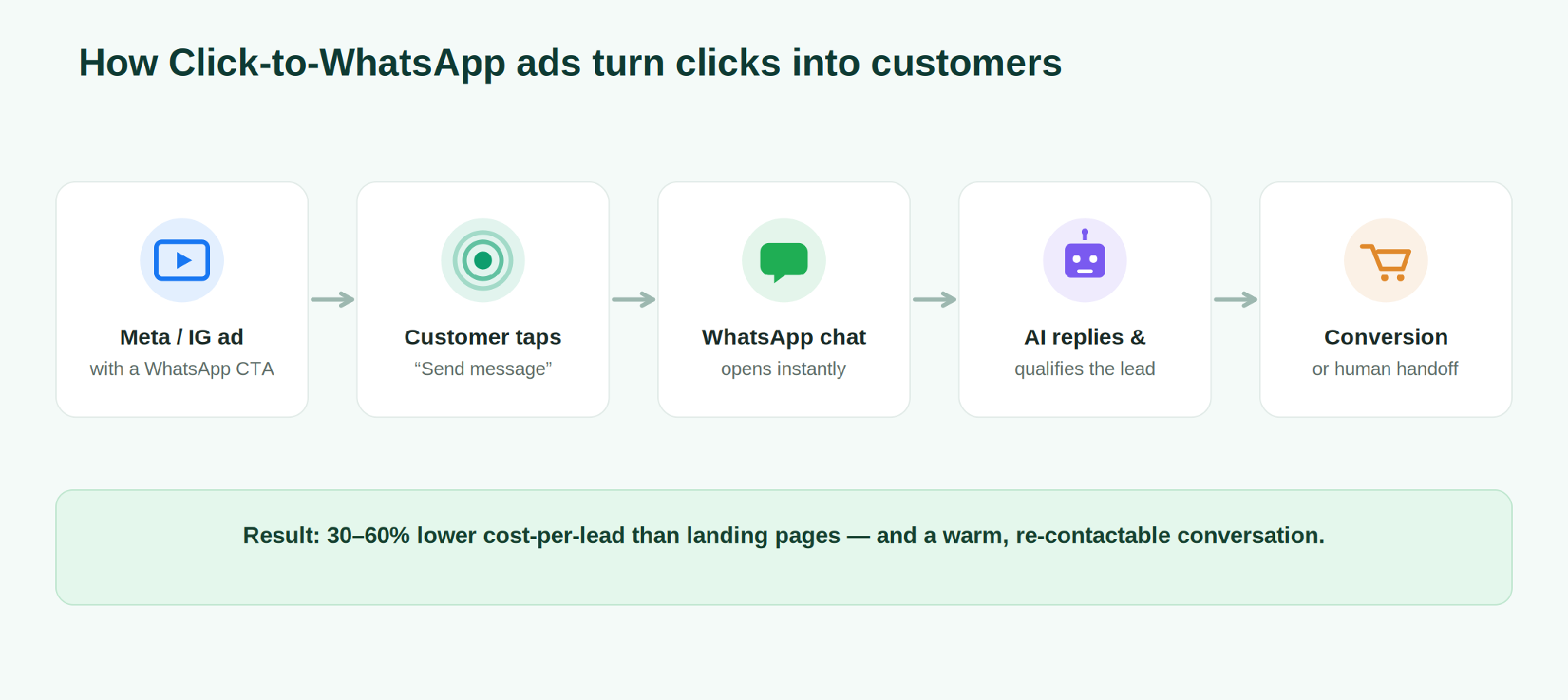
If you do not have an opted-in list yet, Click-to-WhatsApp (CTWA) ads are the quickest way to build one. These are Facebook or Instagram ads whose call-to-action opens a WhatsApp chat instead of a landing page. Someone taps “Send message” and is instantly in a conversation with you — no form, no website to navigate, and they have implicitly opted in by messaging first.
Two reasons CTWA is so effective in India: Indian D2C brands routinely report a 30–60% lower cost-per-lead than landing-page campaigns, and ad-initiated conversations get a free messaging window, so the first stretch of the conversation costs nothing. Pair the ad with an AI that replies instantly and you capture the lead while it is still warm.
How to get started with WhatsApp marketing
- Set up your WhatsApp Business Account (WABA). Choose a BSP and apply for a verified account. You’ll need your Facebook Business Manager ID, a phone number never used for personal WhatsApp, and your business registration details. Approval takes 1–5 business days.
- Build your opted-in list before anything else. Add a WhatsApp opt-in checkbox to your checkout flow, sign-up form, and post-purchase emails. The quality of this list determines every metric you’ll see.
- Create and submit your first templates. Start with utility templates (order confirmation, shipping update) before marketing ones. A clean delivery record on utility messages builds your quality rating and unlocks higher messaging tiers faster.
- Plan your reply flow before you send. Every broadcast generates replies. Decide in advance who handles them, what the AI answers automatically, and what triggers a human handoff.
- Run your first campaign to a small segment. Don’t blast your whole list on day one. Start with your most engaged 10% — they’re least likely to block you, and their positive signal builds your quality rating.
Writing WhatsApp templates that actually convert
WhatsApp marketing templates have hard constraints: they must be approved by Meta, must not be deceptive, and must follow formatting rules. Within those limits, here’s what separates a 60% read-through from a 15% one:
| Element | What works | What doesn't |
|---|---|---|
| Opening line | Personalise with the customer's first name — open rates jump 20–40% | Generic 'Dear Customer' or no personalisation |
| Body copy | One clear message with one clear action. Three sentences max. | Multiple offers, multiple links, paragraph walls |
| Buttons | CTA button ('Shop now', 'Track order') — tap rate 3–5x higher than text links | Asking the customer to copy-paste a URL |
| Media | Product image for shopping, infographic for BFSI — boosts read-through | Low-quality or unrelated stock photography |
| Send time | 10–12 AM or 6–8 PM IST for B2C — when people check their phone | Before 8 AM or after 9 PM |
These patterns reflect aggregate campaign data across SMSLocal’s customer base; individual results vary by vertical and list quality.
Automation: handling replies at scale
The hidden cost of WhatsApp marketing is the replies. A broadcast to 10,000 people at a 5% reply rate is 500 live conversations your team now has to handle — and a broadcast that generates replies and then goes quiet feels like spam to the customer.
The fix is to treat broadcasting and conversation as one product. When a customer replies, agentic AI picks up the thread, answers from your product knowledge base, and escalates to a human only when the conversation genuinely needs one. SMSLocal connects broadcasting and the inbox so every reply is handled instantly, at any volume — which is exactly what turns a one-off campaign into repeat revenue.
How to measure WhatsApp marketing success
- Delivered rate: messages that reached the device. Target >95%; below 90% signals list-hygiene issues or inactive numbers.
- Read rate: delivered messages that were opened. Target 70–90% for opted-in lists; below 50% means audience fatigue.
- Reply rate: contacts who responded. Even 5% on a large list is a strong conversion signal.
- Block rate: contacts who blocked you. Above 1–2% damages your quality rating — stop the campaign and audit your list and template.
- Quality rating: Meta’s aggregate signal (High, Medium, Low) in your WABA dashboard. Let it drop to Low and you lose messaging tiers.
The five mistakes that get numbers banned
- Sending to purchased lists. These contacts never opted in. Block rates will be catastrophic. Don’t do it.
- Ignoring STOP messages. WhatsApp requires you to honour opt-outs within 24 hours. A platform that doesn’t auto-suppress STOP contacts keeps messaging people who asked to leave — generating blocks and reports.
- Sending too frequently. Even opted-in contacts block you if you message every day. Most categories work well at 2–4 messages per month.
- Having no reply plan. Reply with nothing and you get blocked; reply slowly and you lose the conversion.
- Template bait-and-switch. Getting a template approved for one purpose then using it for another is a Terms violation Meta catches during complaints — and can suspend you for.
Businesses that message people who haven’t opted in may face enforcement — messaging restrictions, account suspension, or a permanent ban of the phone number.
How much does WhatsApp marketing cost in India?
You pay Meta a per-conversation fee (a conversation is a 24-hour session you initiate). Marketing conversations in India are currently around ₹0.58–0.78 each, depending on volume. On top of that, your BSP charges a platform fee — per message, per conversation, or as a monthly plan. One way to lower total cost: customer-initiated (service) conversations are cheaper, and Meta includes a monthly allowance of free service conversations, so building a genuine two-way presence pays for itself.
Frequently asked questions
Is WhatsApp marketing legal in India?
Yes — when you use the official WhatsApp Business API and message only contacts who have explicitly opted in. Sending unsolicited bulk messages violates WhatsApp’s Terms and can get your number banned.
Do I need DLT registration for WhatsApp marketing in India?
No. DLT registrationis a TRAI requirement for SMS, not WhatsApp. WhatsApp is governed by Meta’s own Business Policy — you don’t need a DLT sender ID, header, or template. You do need explicit opt-in consent, a verified WhatsApp Business Account, and approved templates.
How is WhatsApp marketing different from bulk WhatsApp messaging?
They overlap. “Bulk WhatsApp messaging” usually refers to the broadcast mechanics — how you send the same template to thousands of opted-in contacts at once. WhatsApp marketing is the wider strategy around it: list building, segmentation, CTWA ads, conversation flows, and measurement. See our full guide to bulk WhatsApp messaging for the sending side.
Can WhatsApp marketing work for B2B?
Yes — often better than B2C, because B2B buyers are more likely to answer a relevant WhatsApp message than an email buried in their inbox. CTWA ads on LinkedIn or Google, paired with an AI that qualifies the lead, are a surprisingly strong top-of-funnel for complex sales cycles.
What’s the difference between the WhatsApp Business App and the API?
The Business App is a free app for very small businesses — one user, no broadcasting, no API, a cap of a few hundred conversations. The WhatsApp Business API (via a BSP) is for businesses that need bulk sending, multiple agents on one inbox, automated replies, and CRM integration. If you’re doing marketing, you need the API.