SMS — Short Message Service — is the text-messaging system built into every mobile network on the planet. Despite being invented in 1992, it remains the most reliable channel for reaching anyone with a phone number, regardless of their internet connection, smartphone model, or app preferences. This guide explains exactly how SMS works, the different types India's regulations define, and why it still outperforms newer messaging channels for several critical use cases.
What SMS actually is
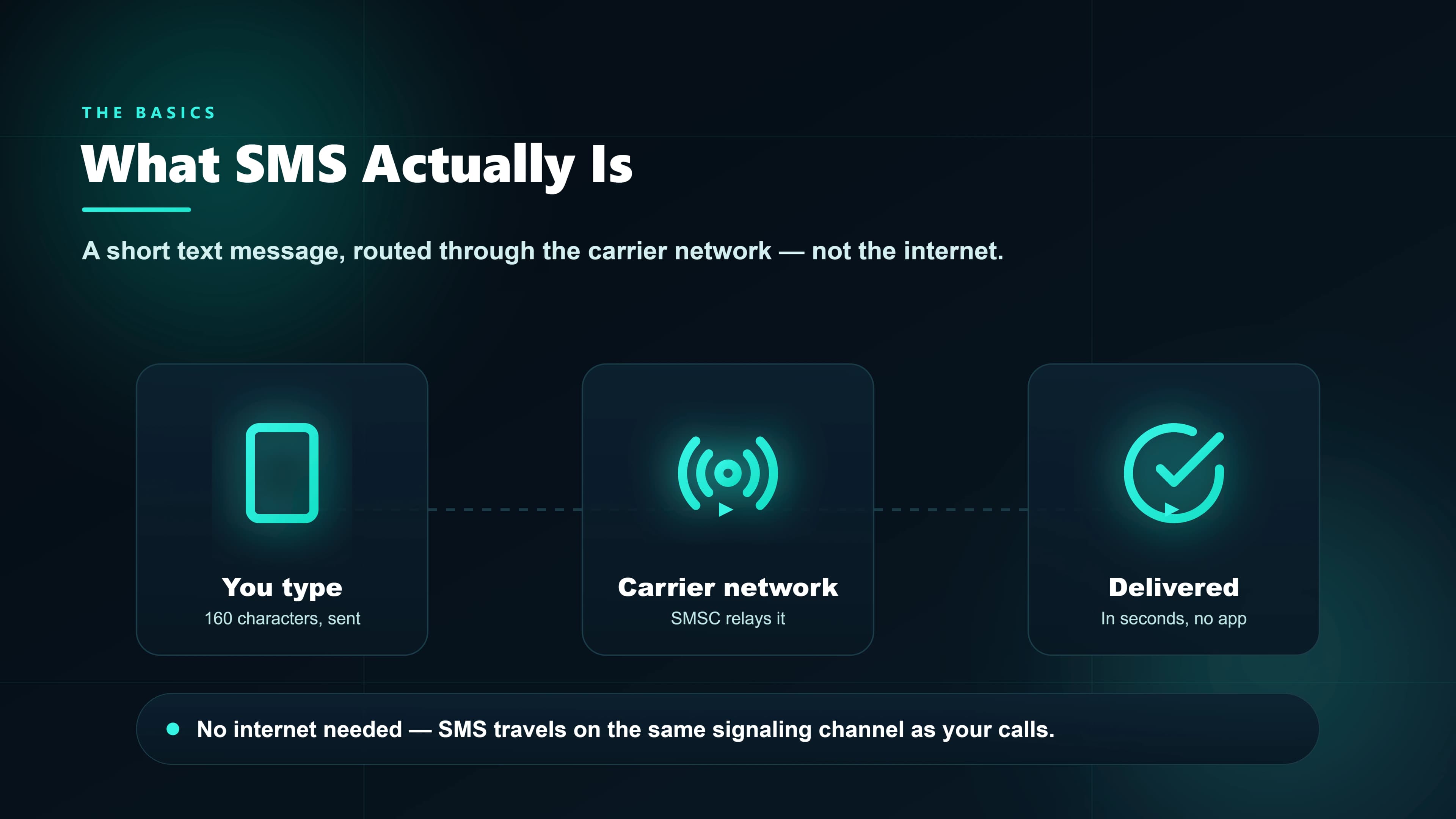
SMS stands for Short Message Service. It is a communication protocol built directly into the GSM mobile standard — the same standard that carries phone calls. Every SIM card ever manufactured supports it; no app installation, no internet connection, and no smartphone are required.
A text message travels through your operator's cellular network — not the internet — and is stored on the operator's SMSC (Short Message Service Centre) until your phone is available to receive it. This store-and-forward architecture means an SMS sent when your phone is off or out of coverage will still arrive when you come back online, often hours later.
The classic limit is 160 characters per SMS (using the GSM-7 character set). Modern phones and networks automatically chain multiple SMS segments into one logical "long message," but each 160-character segment is billed and transmitted separately. For characters outside GSM-7 — Hindi, Tamil, Gujarati, emoji — messages switch to UCS-2 encoding and the per-segment limit drops to 70 characters.
How SMS works technically
When you send a text, here is what happens in under two seconds:
- Your phone sends the message to your operator's SMSC over the control channel of the cellular network — the same signalling layer that handles call setup, not the data layer your 4G apps use.
- The SMSC looks up the recipient's current operator (via the HLR — Home Location Register). If the recipient is on the same network, it delivers directly. If not, it routes to the recipient operator's SMSC through inter-operator agreements called SMS interconnects.
- The recipient's SMSC delivers the message to their handset via a push notification over the paging channel. Their phone confirms receipt, and both SMSCs log a delivery receipt.
- If the recipient's phone is unreachable, the SMSC holds the message for up to 72 hours (the default validity period, configurable per sender) and retries periodically.
The two types of SMS in India
India's telecom regulator TRAI draws a hard legal line between two categories of SMS. The distinction matters for every business that sends messages and for every consumer who receives them.
| Type | What it is | Examples | DND exemption? |
|---|---|---|---|
| Transactional | Service-critical messages the recipient has an implied or explicit relationship with the sender for | OTPs, payment receipts, delivery tracking, bank alerts, appointment reminders, flight updates | Yes — delivered even to DND numbers |
| Promotional | Marketing or commercial communication intended to sell, promote, or advertise | Discount codes, product launches, event invites, sale announcements | No — blocked by DND, subject to send-window restrictions |
A third sub-category — OTP (One-Time Password) SMS — is treated as transactional but has its own dedicated routing infrastructure. OTPs must arrive within seconds, so operators give them priority queuing and they bypass most congestion filtering.
SMS vs WhatsApp: what actually differs
WhatsApp has 500 million monthly active users in India, more than any other messaging app. Yet SMS continues to dominate for several high-stakes use cases. Here is the practical comparison:
| Factor | SMS | |
|---|---|---|
| Requires internet | No | Yes |
| Requires app install | No | Yes |
| Delivery to feature phones | Yes | No |
| Delivery to offline device | Yes (SMSC holds up to 72 h) | No (requires internet on delivery) |
| OTP / time-sensitive alerts | Industry standard | Possible but slower |
| Rich media (images, video) | No (plain text only) | Yes |
| Two-way conversation | Limited (short-code or longcode) | Full thread |
| TRAI regulation | Yes (DLT, DND, send windows) | Separate (Meta BSP rules) |
| Cost per message (India) | ₹0.03–0.15 | ₹0.20–0.80 (conversation-based) |
SMS in India: the regulatory context
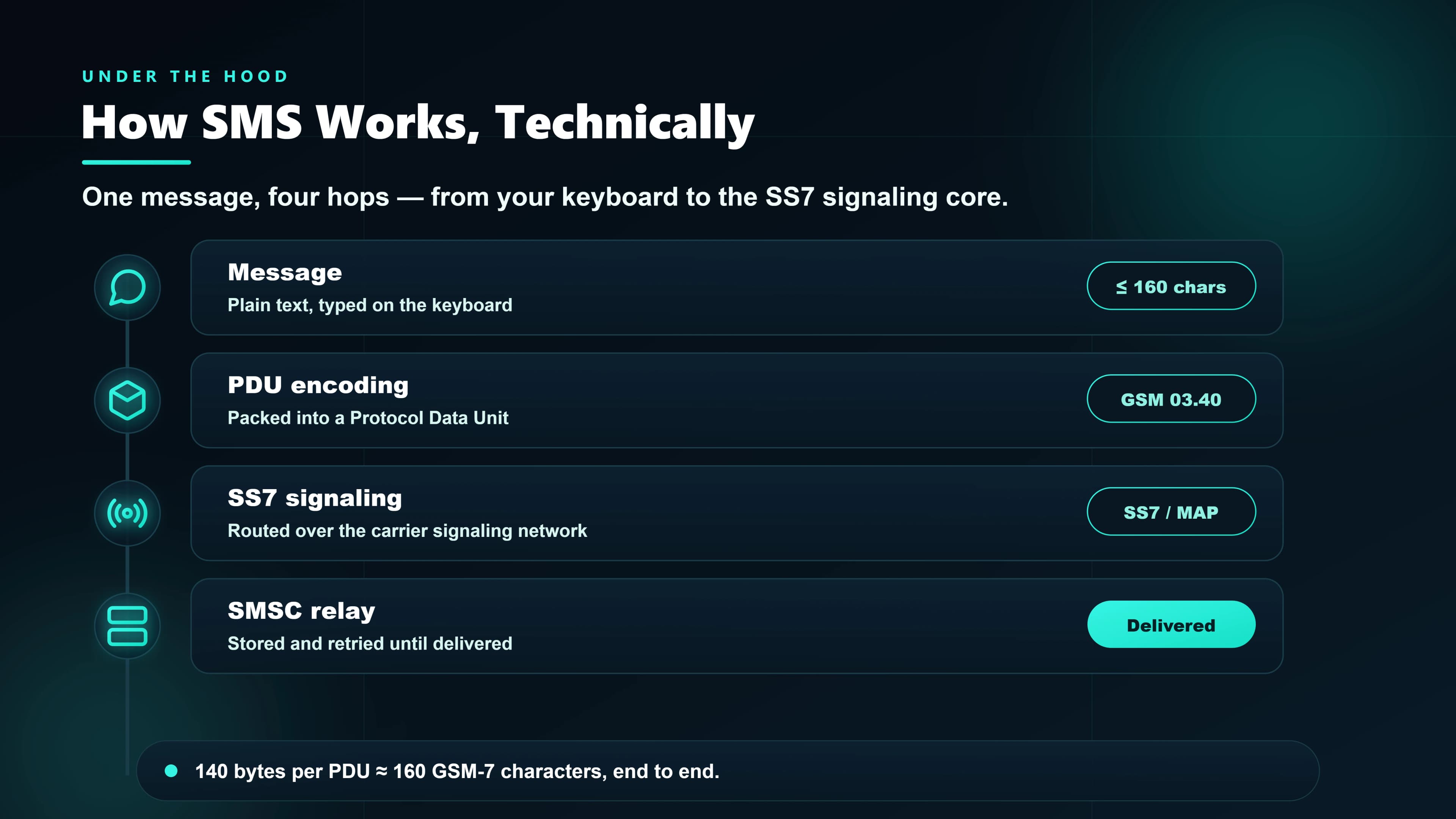
India has one of the most sophisticated SMS compliance frameworks in the world, built on three pillars:
1. DLT (Distributed Ledger Technology) registration
Since 2021, every business that sends commercial SMS in India must register on a blockchain-based platform called DLT. Registration covers three things:
- Principal Entity (PE) registration — your company's identity, verified with GST, PAN, and authorisation letter
- Header (Sender ID) — the 6-character alphanumeric tag that appears in place of a phone number (e.g. SMSLTD)
- Content templates — every message template pre-approved by the regulator before sending
Unregistered SMS from a 6-character header are automatically blocked by all major operators. See our complete DLT registration guide for the step-by-step process.
2. DND (Do Not Disturb) scrubbing
Every promotional SMS must be scrubbed against the National Customer Preference Register (NCPR) — commonly called the DND list — before delivery. Sending promotional SMS to a DND-registered number is a TRAI violation that can result in sender ID suspension. Transactional SMS is exempt from DND.
3. Send windows for promotional SMS
TRAI restricts promotional SMS to the window between 9:00 AM and 9:00 PM local time. Messages submitted outside this window are queued by operators and delivered at 9 AM the next day.
SMS for business: the practical use cases
Businesses in India use SMS for two broad categories:
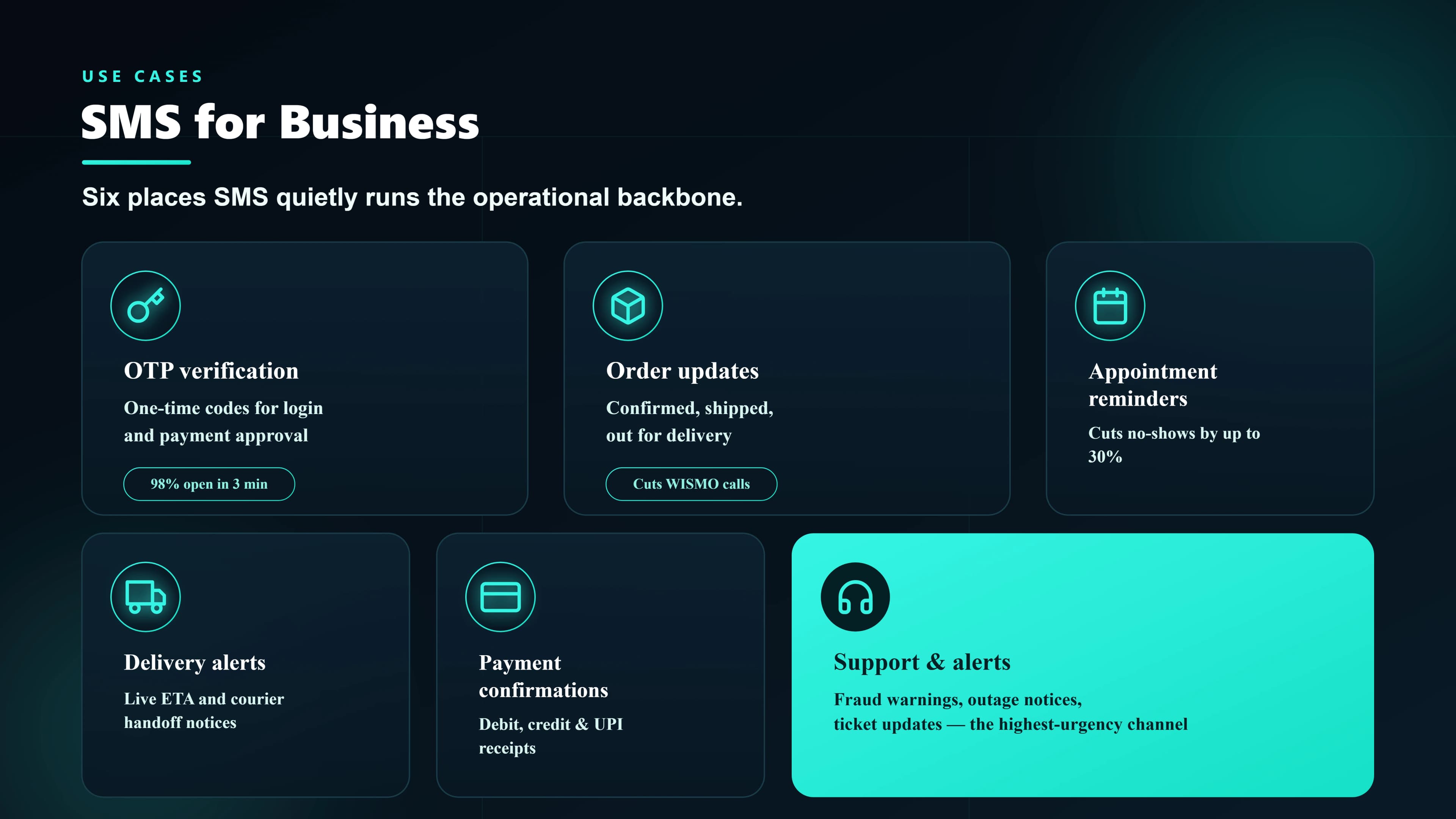
Transactional SMS
- OTPs and 2FA — account login, payment authorisation, form verification. Industry benchmark: 98%+ delivery within 5 seconds.
- Order and delivery notifications — dispatch alerts, tracking links, delivery confirmations, return labels.
- Payment confirmations — receipts, EMI reminders, subscription renewals.
- Appointment reminders — clinic, banking, government service bookings.
- System alerts — server downtime, threshold alerts, staff notifications.
Promotional SMS
- Sale and offer announcements — discount codes, flash sales, seasonal promotions. Average open rate in India: 85–90%, typically within 3 minutes.
- Event invitations — webinar registration, store opening, product launch.
- Re-engagement campaigns — win-back offers for lapsed customers.
- Survey and feedback requests — short 1–2 question follow-ups with a reply keyword.
Character limits and encoding
Understanding SMS encoding prevents a common and expensive mistake: sending what you think is one message but the network splits into two and charges you double.
| Encoding | Characters per single SMS | Characters per segment (multi-part) | When triggered |
|---|---|---|---|
| GSM-7 | 160 | 153 | Standard Latin letters, digits, common punctuation |
| UCS-2 | 70 | 67 | Any character outside GSM-7: Hindi, Tamil, Telugu, emoji, smart quotes |
Frequently asked questions
India processes over 1.5 billion commercial SMS messages every day — more than any other country on the planet.