Telegram sends a verification code to your phone number when you sign in from a new device. In most cases the code arrives via the Telegram app itself — but when you're not already logged in anywhere, it falls back to SMS. If that SMS isn't arriving, the reasons are well-understood and all fixable. This guide walks through how Telegram's verification system works, every reason the SMS code might not reach you, and exactly what to do in each case.
How Telegram's verification works
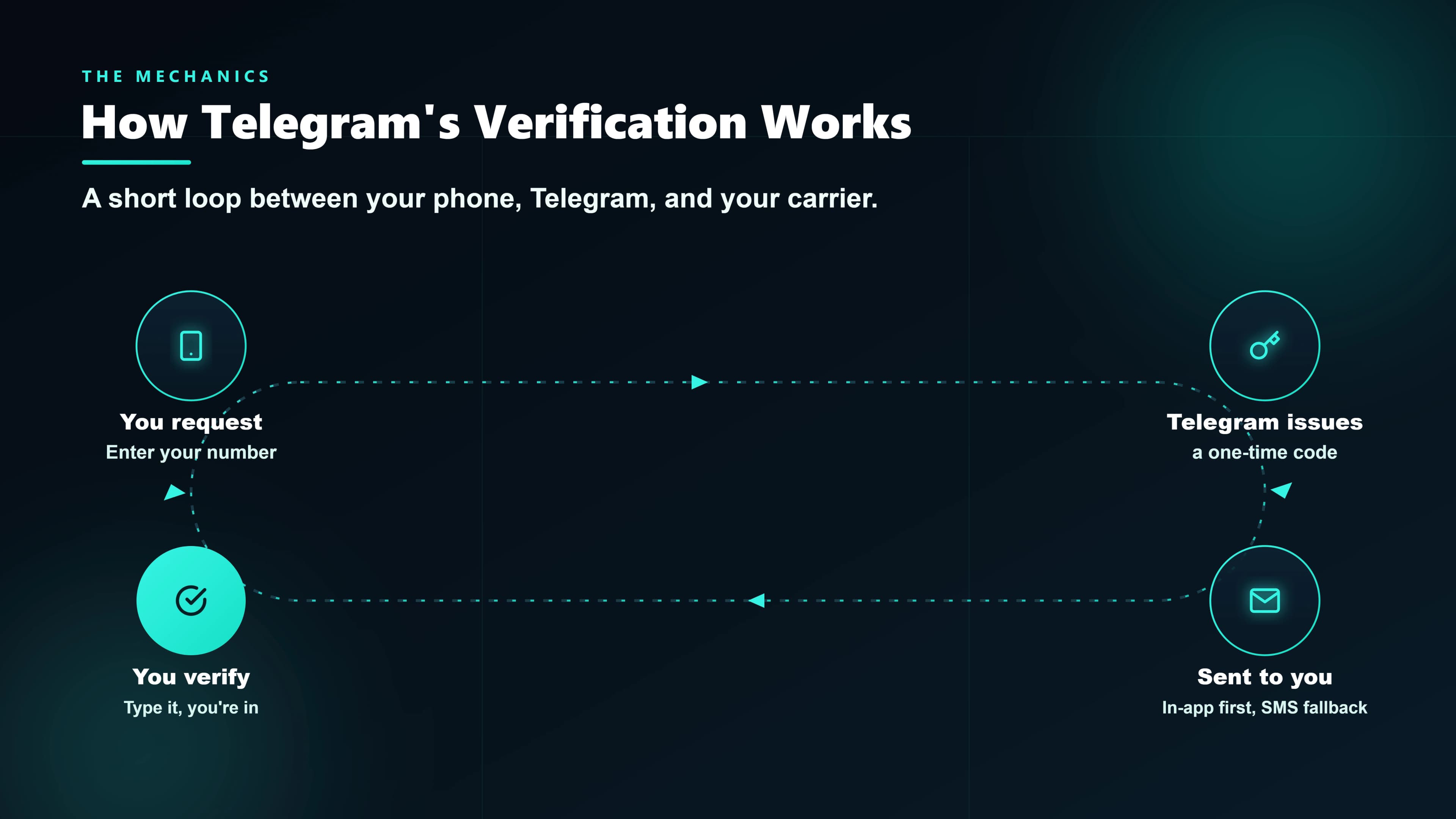
When you enter your phone number in the Telegram app, the platform attempts verification in a specific order:
- Telegram app on another device — if you are already logged into Telegram on a different phone or desktop, the code appears as a message inside that Telegram session, not as an SMS. This is the default and most secure method.
- SMS fallback — if you have no other active Telegram session (logging in for the first time, or all other devices are logged out), Telegram sends a 5-digit code via SMS to the registered phone number.
- Voice call fallback— if the SMS fails to deliver within about 60 seconds, Telegram offers a “Call me” option. The code is read aloud by an automated IVR call.
Why the Telegram SMS code isn't arriving
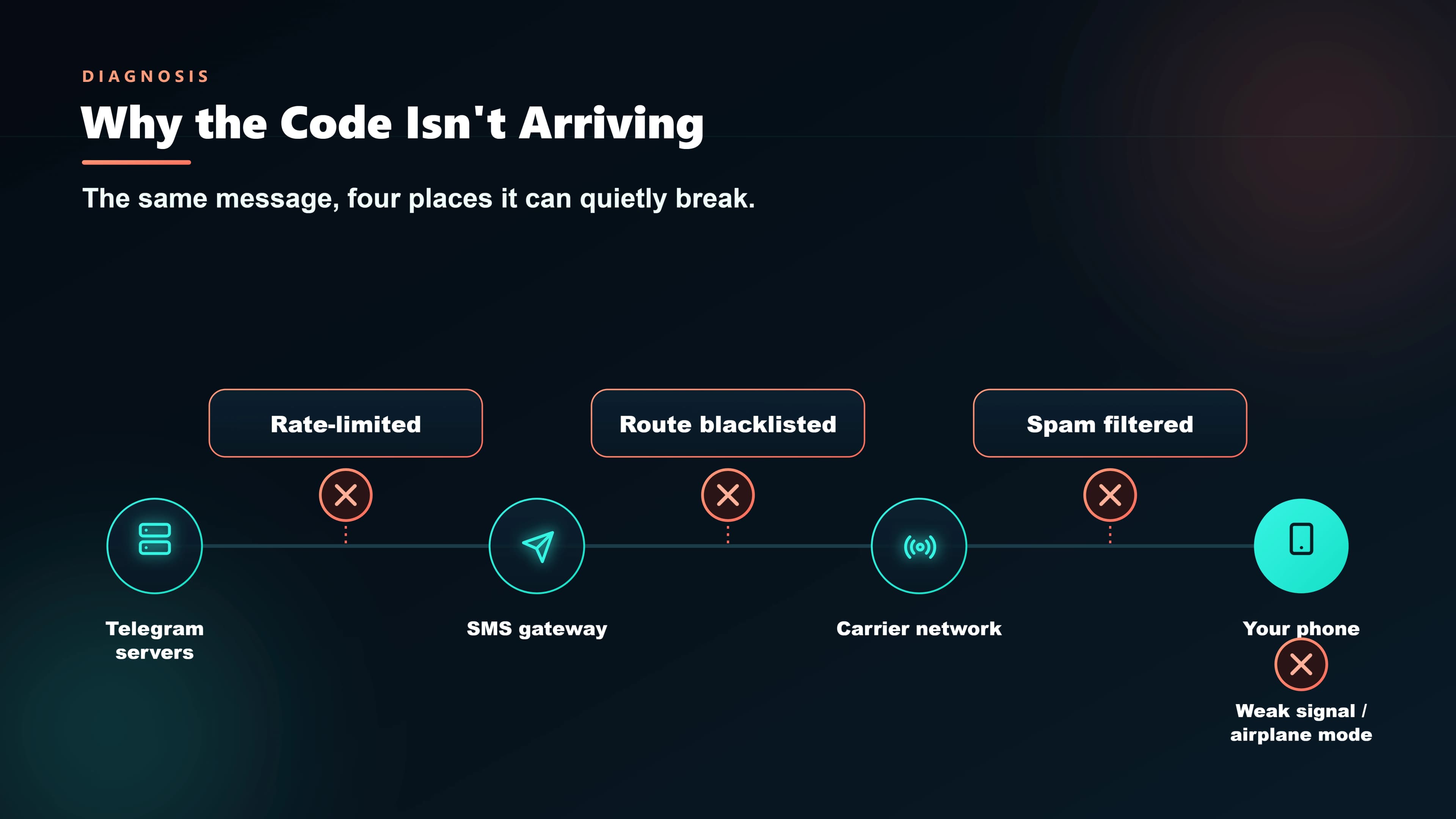
If you've confirmed there is no other active Telegram session and the SMS still has not arrived after 2 minutes, one of these is usually the cause:
1. Wrong number registered
Telegram sends the code to the number associated with the account, not necessarily the SIM currently in your phone. If you changed your phone number since you last used Telegram but didn't update it in settings, the SMS goes to your old number.
Fix: Try the old number in the login field. If you no longer have access to the old SIM, use the account recovery form (covered below).
2. DND (Do Not Disturb) active on your number
India's TRAI DND framework distinguishes transactional SMS(OTPs, alerts) from promotional SMS. OTPs are classified as transactional and should bypass DND. However, Telegram's SMS routing may pass through a commercial aggregator using a header registered under a content category that gets flagged as promotional on some operators.
Fix: Temporarily deactivate DND by sending STOP to 1909, wait 10 minutes, then request the code again. Re-activate DND by sending START 0 to 1909 once logged in.
3. SMS blocked by your operator or spam filter
Some operators block SMS from international senders or from certain short codes, especially on prepaid SIMs. Telegram's SMS may originate from an international number or a code your operator flags as suspicious.
Fix:Check your phone's spam or blocked messages folder. On Android, open Messages → ⋮ → Spam & blocked. If it's there, mark it as “not spam.”
4. iMessage intercepting the number (iPhone)
On iPhones with iMessage enabled, if the sender's number is in your contacts as an iMessage user, iOS may route the message through iMessage rather than SMS. Telegram's verification codes won't arrive via iMessage.
Fix:Go to Settings → Messages → Send & Receive and make sure your number is active for SMS/MMS (green, not blue). Temporarily toggle iMessage off, request the code, then re-enable.
5. SIM not inserted or not primary SIM on dual-SIM phones
On dual-SIM devices, Telegram sends the code to the number you entered — but the default SMS SIM may be different from the number you registered with Telegram.
Fix:Check which SIM is active. On Android: Settings → Network & internet → SIM cards. Ensure the SIM associated with your Telegram number is inserted and set as the SMS SIM.
6. Network congestion or routing delay
International SMS routing (Telegram's servers are outside India) can occasionally be delayed by 2–10 minutes during peak periods. This is more common on Vi (Vodafone Idea) and BSNL than on Jio or Airtel.
Fix:Wait 2 minutes and try the “Call me” option instead. A voice call bypasses most SMS routing issues.
Step-by-step fix
Work through these in order — most people resolve the issue by step 3:
- Check other devices — open Telegram on every phone, tablet, or desktop where you might be logged in. The code is likely there.
- Wait 2 minutes— then tap “Call me instead.” The automated call is almost always faster than SMS when there are routing delays.
- Check spam/blocked messages— on Android: Messages → ⋮ → Spam & blocked. On iPhone: Filters → Unknown Senders.
- Verify the correct number— confirm you're logging in with the number Telegram has on record. Try formatting with and without the country code (+91 vs 91 vs 0).
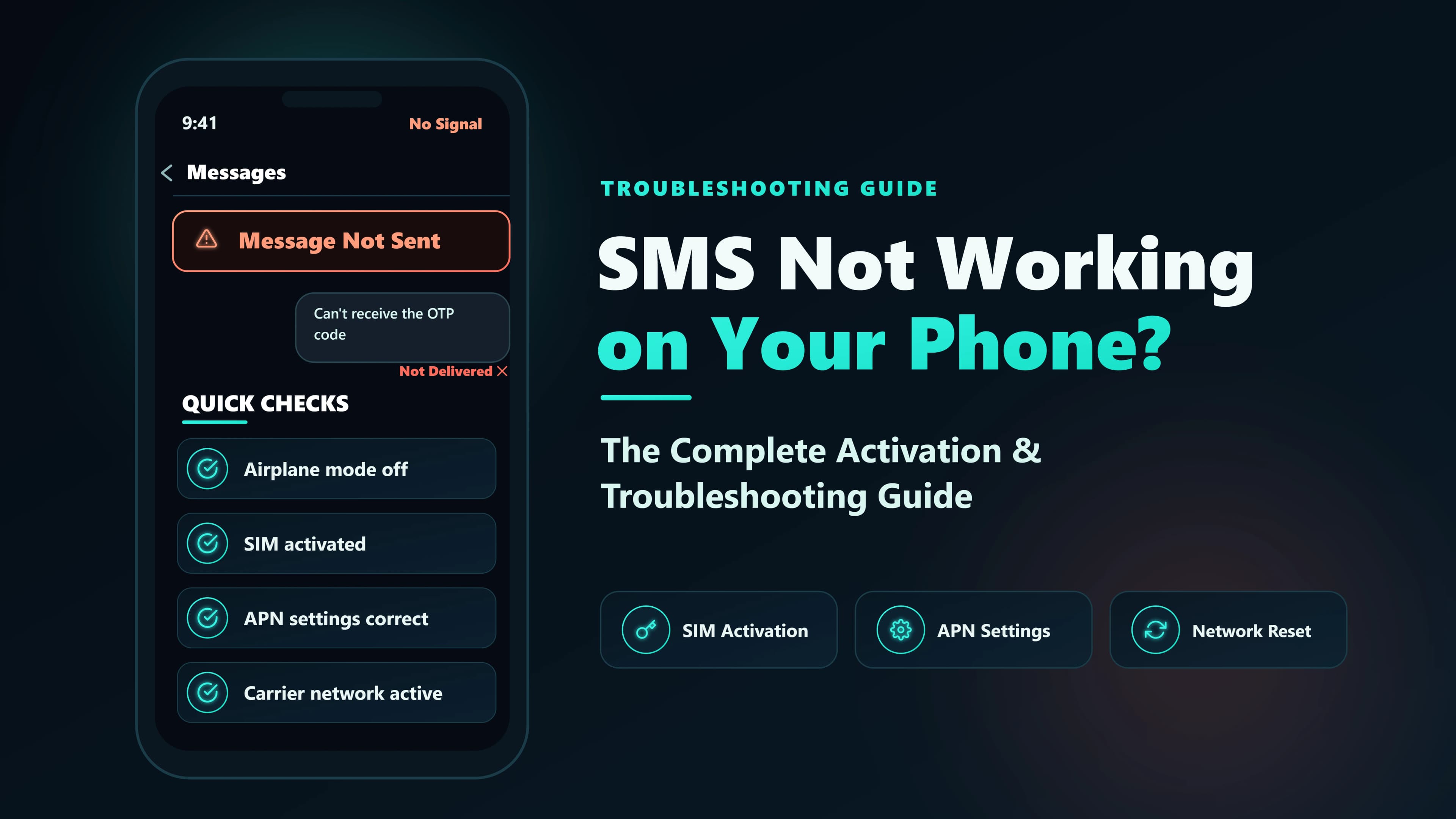
- Restart your phone — clears carrier network registration issues that can block incoming SMS. If SMS problems persist on your device generally, see our SMS not working guide for the full device-level checklist.
- Temporarily deactivate DND — send STOP to 1909, wait 10 minutes, request the code again.
- Try a different network— if possible, switch to Wi-Fi calling or use a different SIM temporarily to check if it's an operator-specific block.
Using the voice call option
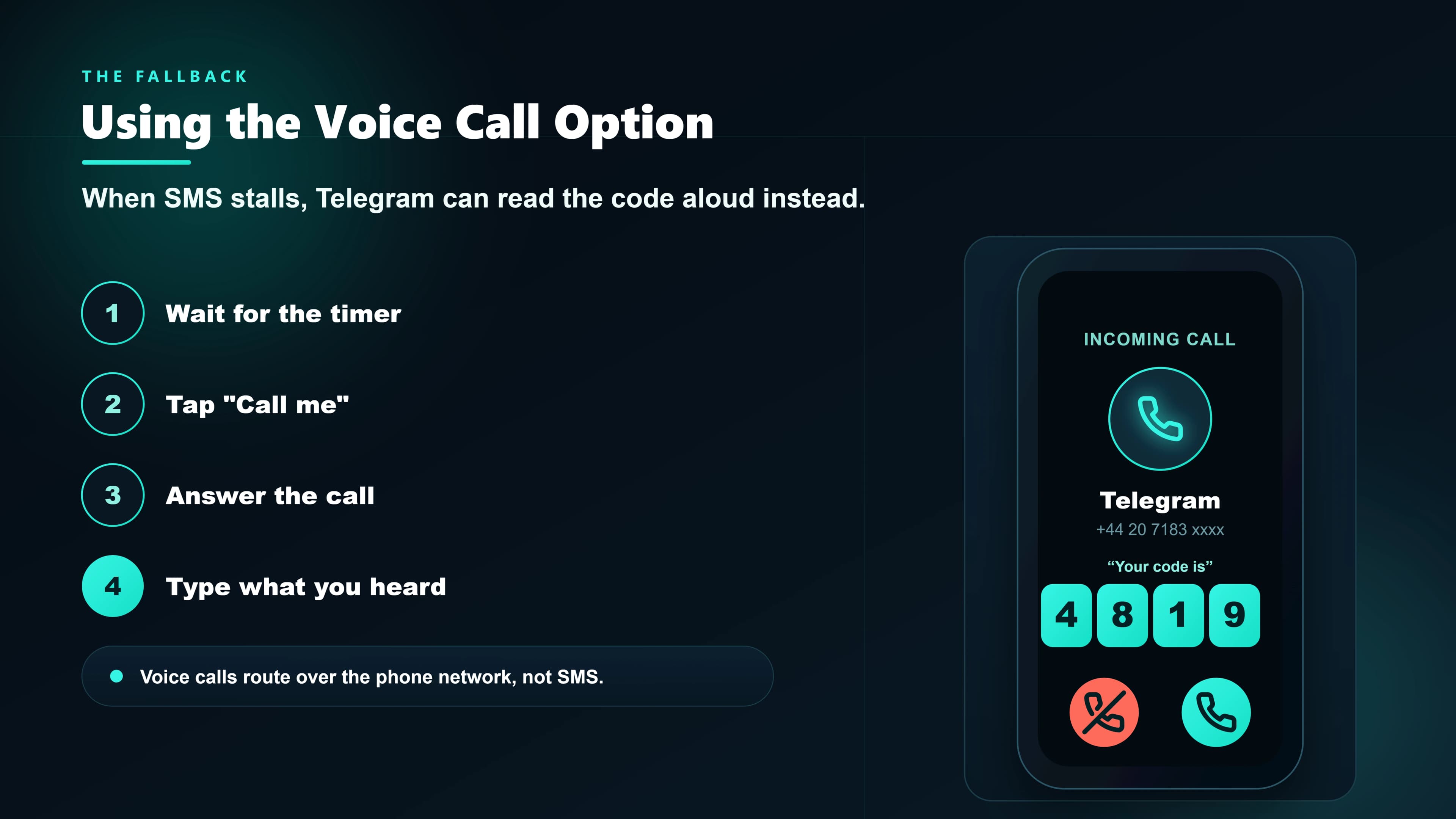
The “Call me instead” button appears on the Telegram login screen about 60 seconds after the SMS is sent. This is often the fastest resolution:
- An automated call connects to your phone within 10–30 seconds
- A voice reads the 5-digit code twice, slowly
- The code is the same code that would have come via SMS — enter it in the app
- Voice calls bypass DND restrictions and most SMS blocks
What to do if you've lost access to the phone number
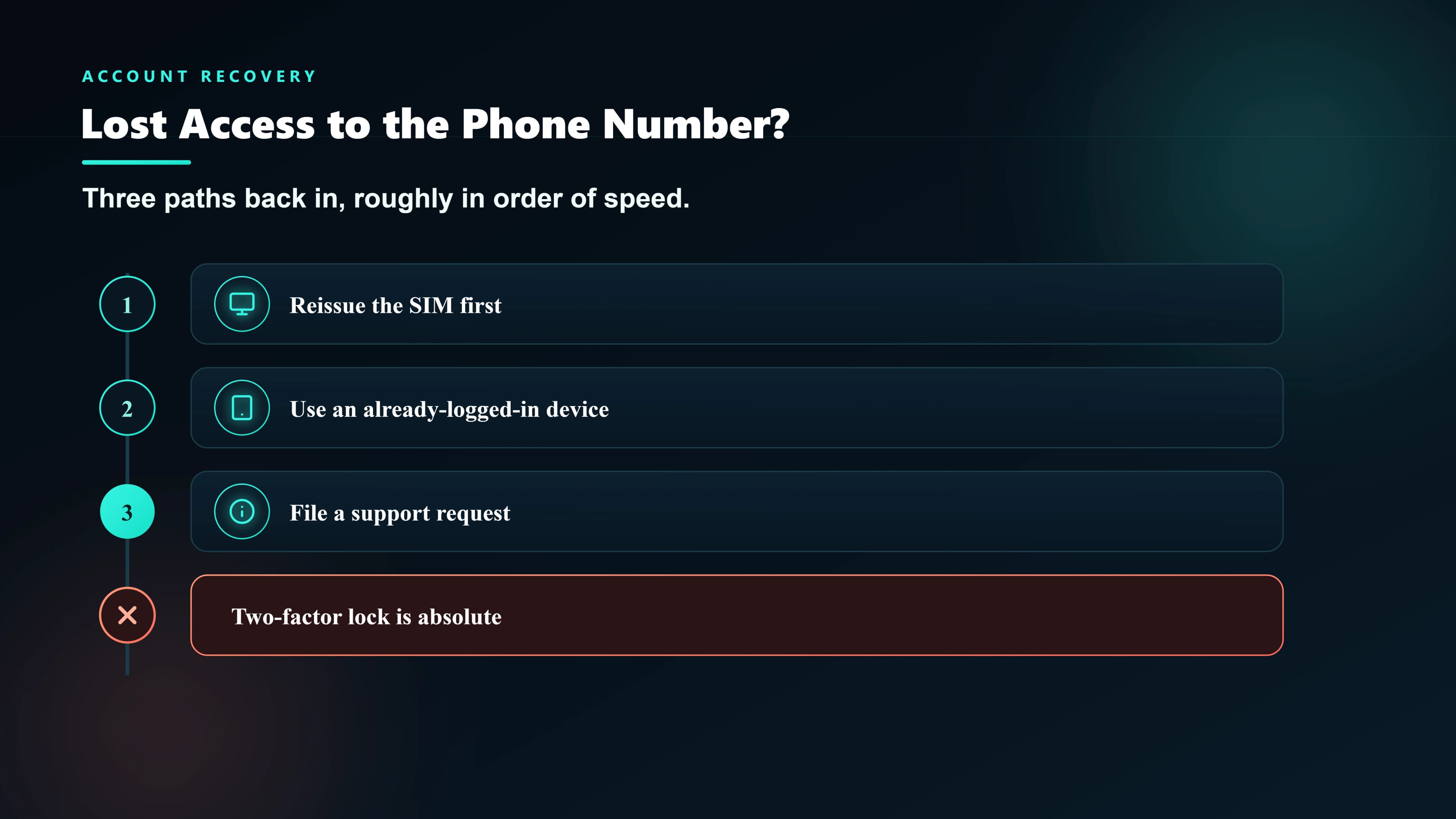
If you no longer have the SIM registered to your Telegram account (lost phone, changed number, ported to a different operator and SIM expired), recovery is more difficult:
- Check for an active desktop session — Telegram Web (web.telegram.org) or the desktop app may still be logged in. If so, you can change your phone number from within Settings → Phone number.
- Use Telegram's account deletion flow — if you have a new number, you can create a new Telegram account on it. Telegram accounts tied to an unused number are automatically deleted after 6 months of inactivity, freeing the account.
- Contact Telegram support— Telegram's account recovery support is limited by design (the system is built to resist unauthorised recovery). File a request at telegram.org/support and include as much account ownership evidence as possible.
Security implications of SMS verification
Telegram's SMS-based login has a known security limitation: anyone who can intercept or forward your SMS (via a SIM-swap attack, for example) can log into your Telegram account. To reduce this risk:
- Enable Two-Step Verification — Settings → Privacy and Security → Two- Step Verification. This adds a password requirement on top of the SMS code. Even if someone receives your verification SMS, they cannot log in without the password.
- Set an account self-destruct timer — Settings → Privacy → Delete My Account. If your account is inactive for 1–6 months, Telegram deletes it, preventing long-term dormant account hijacking.
- Monitor active sessions— Settings → Privacy → Active Sessions. Review and terminate any sessions you don't recognise.
| Threat | Risk without 2SV | Risk with 2SV enabled |
|---|---|---|
| SIM-swap attack | Account fully compromised | Attacker still needs your password |
| SMS interception | Account accessible | Password still required |
| Lost phone | Account accessible to finder | Password + remote session termination |
| Phishing for code | Account compromised | Password still required |
Frequently asked questions
If you receive a login code without requesting one, someone may be attempting to log into your account. Do not share the code with anyone.